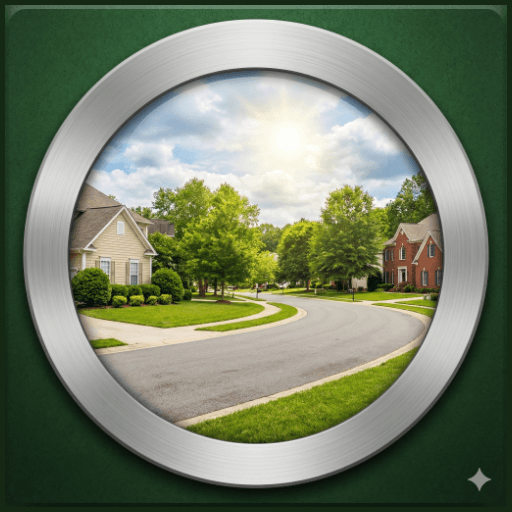
Gwarinpa Estate Security: Coordinating Safety Across West Africa's Largest Single Housing Estate
How security coordination actually works in Gwarinpa, Abuja: the police division, the Federal Housing Authority, the area council ward and the estate associations that share the job, plus what verified residents can organise across seven avenues.

Scale is the security problem before anything else
Gwarimpa Estate covers roughly 1,090 hectares and is divided into seven residential areas marked out by wide avenues. Wikipedia and Daily Trust both describe it as the largest single housing estate in Nigeria and in West Africa, and administratively it is a ward of the Abuja Municipal Area Council, one of twelve. Schools, markets, clinics and business clusters sit inside the estate, so much of daily life never has to leave it.
That size is the constraint. A gate notice, a warning about a vehicle circling a street, or a transformer that has been off since Friday has to travel a long way, and the channels residents actually use reach only the people already in one chat. Three avenues away, the same news arrives later and changed.
The second complication is that no single body owns the answer. Policing, building control, area-council representation, estate associations, contracted guard firms and informal watch groups all touch the same streets, and residents rarely know which one a question belongs to. Coordination here starts with mapping those layers rather than buying equipment.
Who is actually responsible around Gwarinpa
Policing runs through the Nigeria Police Force's FCT Command, and Gwarinpa is served by its own division, Gwarinpa Division, under a Divisional Police Officer. The Force publishes a locator for commands and divisional headquarters, which is the first step for a resident who wants to know where an incident formally belongs rather than who happens to be online.
Building control is a separate authority, and it touches street life more than people expect. The Federal Housing Authority allocated the original residential grid and still governs approved plans. On 23 November 2024 it announced the suspension of all developments in its Gwarinpa and Apo/Guzape estates until it had concluded a review, citing deliberate departures from approved plans; the FHA press release, Guardian and Punch all carried that the same day. A conversion under way on your avenue may be an unapproved job, and the body that controls the plans is neither the gate nor the police.
Residents fund the rest directly. Associations hire guard firms, set gate rules and collect dues, and individual clusters run their own barriers and visitor registers. Neighbourhood watch and vigilante groups also operate: International Crisis Group's April 2022 Africa Report No. 308 treats community and neighbourhood watch groups as a recognised category filling gaps people no longer expect the state to cover, and Guardian reported in November 2022 that Abuja residents who had lost confidence in the response turned to vigilante services because they arrived faster.
None of those are apps, and the boundary is worth stating plainly: Watchdoor does not patrol, cannot dispatch, and has no agreement with the police, the FHA, the area council or any watch group. Its only role here is the record.
What an association and its neighbours can handle themselves
Once the layers are clear, the workable middle is what an association and its street can settle without waiting on anyone. These questions decide whether information moves across seven avenues or dies inside one group chat. Written answers cost nothing and separate an estate that runs on memory from one that runs on a protocol anyone can quote.
- Which gates are staffed overnight, and what a visitor needs before arriving rather than at the barrier
- Whether the association has a duty contact for each avenue and a written escalation path to the division
- How a contractor or artisan gets cleared for a working day, and who signs for that
- Which avenue a notice is meant for, so the whole estate is not alerted to a pothole
- How an incident reaches the police rather than only the chat, and what reference the caller was given
- How long a failed light, a stuck barrier or an unreviewed building job has been outstanding, with a date on every entry
The alert that helps and the alert that spreads fear
Most estate warnings fail the same way: they say something bad happened without saying what to do differently. A useful post carries five things. Where, named as neighbours name it, which in Gwarinpa means the avenue plus a landmark rather than the estate. What you actually saw, in a sentence or two, with anything you did not see marked as unknown. When, with an hour. Whether the gate, the association or the division has acknowledged it. And whether anything changes for the reader today.
What has no place in a warning is a name or photograph presenting an identifiable person as a suspect, an asserted cause nobody witnessed, or blame pointed at a gate, a contractor or a community. Crisis Group is blunt that poorly trained watch groups have committed serious abuses, and speculation is normally what takes a street from caution to a mob. Do not follow a vehicle, do not confront anyone, do not invite people to come and see. If something is happening, the number that matters is the police line.
The quiet benefit of writing it properly is the archive. An association that can put five dated reports for one avenue in front of a Divisional Police Officer is having a different conversation from one that says there have been many incidents lately. Dates and place names turn a complaint into a pattern.
What changes when the roster is verified
A group chat is built for conversation, and security coordination is not mainly a conversation. Notices scroll away, nobody can tell whether the author lives inside the estate or passed through once, and one warning arrives four times in four versions. A verified resident space is organised the other way round: the roster is tied to a place, a notice can be pinned to the avenue it concerns, and who said what and when survives the week.
That matters most for the unglamorous parts, which in a district this size is where trust is won or lost: a dues reminder everyone can see, a maintenance notice with a date, a gate closure before a public holiday, a plumber three neighbours have already vouched for. New residents arriving from Wuse or Lokogoma also get the answer to their first question, which is not dramatic: who here is actually in charge of my street.
Verification raises a privacy question an association should ask before it signs anything. A resident roster, a gate register and a visitor log are personal data, and the framework established under the Nigeria Data Protection Act 2023 is administered by the Nigeria Data Protection Commission. Names, phone numbers, plate numbers and movement patterns are exactly what a platform ends up holding. That is not legal advice; it is a shortlist of questions for a vendor and a minute for the association to record.
Getting your own avenue onto one page
Start narrow. One avenue, one association or gate committee, one written protocol covering overnight staffing, visitor clearance and how an incident reaches the division. Put the duty contact somewhere residents can find at midnight, and keep a dated log of gate closures, maintenance faults and unresolved building complaints, because that log is the strongest document an estate can bring to any authority.
Then choose the channel by the job it has to do. Access control at a barrier belongs to the gate. A shared, place-labelled record for verified residents is a different job, and in Gwarinpa it is not a luxury: it is how seven avenues stop behaving like seven villages that only compare notes after something has already gone wrong.
Sources used for this article
Quick answers
Is Gwarinpa really the largest housing estate in West Africa?
Wikipedia and Daily Trust both describe it as the largest single housing estate in Nigeria and in West Africa, on about 1,090 hectares and divided into seven residential areas marked out by wide avenues. The claim is about one planned estate rather than Abuja's wider districts, and the practical consequence is distance: two ends of the same estate behave like two neighbourhoods.
Who polices Gwarinpa Estate?
The Nigeria Police Force's FCT Command covers it through Gwarinpa Division, led by a Divisional Police Officer, and the Force's site lists commands and divisional headquarters. Around the estate you also find private guard firms contracted by residents' associations, gate controls on individual clusters, and neighbourhood watch arrangements that International Crisis Group documented in its 2022 report on vigilantism.
Can a neighbourhood app replace estate security?
No, and Watchdoor does not claim to. It does not patrol, does not dispatch anyone, and has no agreement with the police, the Federal Housing Authority, the Abuja Municipal Area Council or any watch group. Its only useful function is keeping a dated, place-labelled record that verified neighbours contribute to, so an association and a divisional police officer work from the same picture rather than a rumour.
What does the Federal Housing Authority have to do with security?
The Federal Housing Authority allocated the original residential grid in Gwarinpa and remains the authority over approved building plans in its estates. On 23 November 2024 it announced the suspension of all developments in its Gwarinpa and Apo/Guzape estates until it had reviewed those plans, citing departures from what was approved. The FHA, Guardian and Punch all reported it that day.
What should I never post about an incident in the estate?
Never publish a name or photograph that presents an identifiable person as a suspect, never assert a cause you did not witness, and never aim blame at a gate, a contractor or any community or place of origin. Crisis Group warns that poorly trained watch groups have committed serious abuses, and speculation is usually what takes a street there. Report to the police line first, then write down what you saw, where and when.
More from the Watchdoor blog
Keep exploring Watchdoor
Use the feature overview to understand the full platform, or visit the business page to see how local growth tools fit into the broader neighborhood product.